

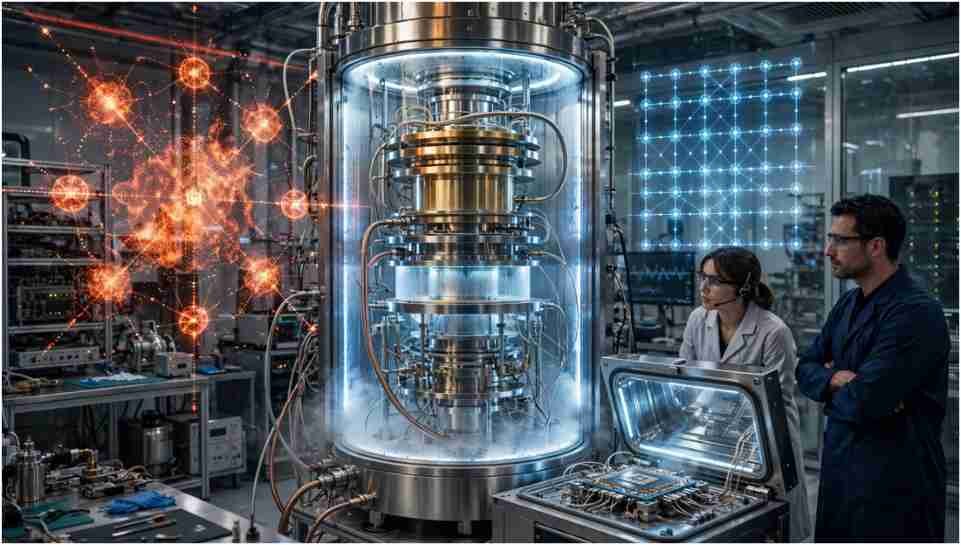
When I compare quantum announcements from early 2024 with those from December, the shift is hard to miss. How quantum computing changed in 2024 was less about building machines with eye-catching qubit totals and more about proving those qubits could become reliable enough to matter.
The year did not deliver a universal fault-tolerant quantum computer. What it delivered was arguably more useful: evidence that error correction, logical qubits, mature software, hybrid computing, and quantum-safe security were moving from theory toward engineering.
2024 Quantum Computing Changes at a Glance
| Area | What changed in 2024 | Why it mattered |
| Hardware | Error suppression gained priority over raw qubit counts | Reliability became the better progress metric |
| Logical qubits | Microsoft and Quantinuum demonstrated highly reliable logical qubits | Strengthened the path toward fault tolerance |
| Error correction | Google Willow demonstrated below-threshold behavior | More qubits could reduce, rather than multiply, errors |
| Software | IBM released Qiskit 1.0 | Developers gained a more stable SDK |
| Security | NIST finalized three PQC standards | Organizations could begin concrete migrations |
| Investment | Funding became more selective | Capital increasingly favored credible paths to scale |
Why How Quantum Computing Changed In 2024 Is a Reliability Story
For years, quantum computing headlines often centered on physical-qubit counts. That number still matters, but 2024 exposed its limits.
A processor with thousands of unstable qubits may be less useful than a smaller architecture that can protect quantum information.
That is why I view how quantum computing changed in 2024 through a different metric: what happens to errors when a system grows?
Microsoft and Quantinuum Made Logical Qubits More Credible
In April, Microsoft and Quantinuum reported four logical qubits created using Quantinuum hardware and Microsoft’s qubit-virtualization system. Their logical error rates were reported as 800 times lower than corresponding physical error rates. The teams also completed more than 14,000 circuit experiments without an error.
By September, the collaboration had expanded the demonstration to 12 logical qubits on Quantinuum’s 56-physical-qubit H2 machine. Microsoft also combined logical qubits with AI and high-performance computing in an end-to-end chemistry workflow.
I call this the 2024 reliability ladder: four logical qubits in April, 12 by September, followed by another major error-correction result in December.
The important number was no longer simply “how many qubits?” It became “how reliably can those qubits preserve and process information?”
Google Willow Pushed Error Correction Below Threshold
December produced one of the year’s most important hardware results.
Google’s 105-qubit Willow processor demonstrated below-threshold quantum error correction. Google tested progressively larger encoded grids and reported that each increase in code size cut the logical error rate roughly in half.
That distinction explains how quantum computing changed in 2024 better than a spectacular benchmark alone.
Quantum error correction works only if adding physical qubits for protection ultimately lowers logical errors. Willow supplied evidence that this scaling behavior can work in a superconducting architecture.
The result did not mean fault-tolerant quantum computing had arrived. It showed that one of the underlying scaling assumptions had survived a demanding experimental test.
Quantum Software Became More Stable and Practical
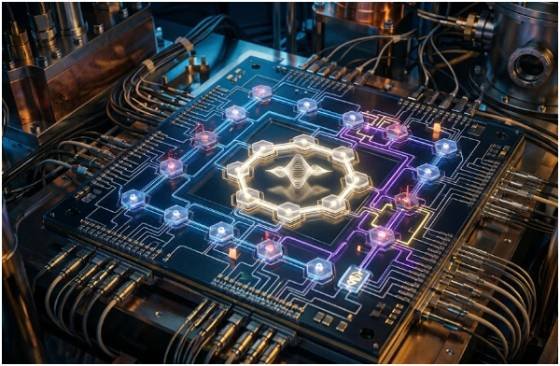
Hardware gets the dramatic headlines, but software maturity was another part of how quantum computing changed in 2024.
Quantum developers need stable abstractions, optimized circuit tools, cloud access, and ways to coordinate quantum processors with classical computing. Without that layer, better hardware remains difficult to use.
Qiskit 1.0 Marked a Software Maturity Point
IBM released Qiskit SDK 1.0 in February 2024. IBM described the release as the beginning of a phase focused on performance, stability, and usability.
That might sound less exciting than a new processor, but stable developer tooling matters enormously.
It lets researchers and businesses build workflows through business automation against a more predictable software foundation. It also reflects an industry moving beyond experimental programming interfaces toward longer-lived development ecosystems.
AI Began Assisting Quantum Development
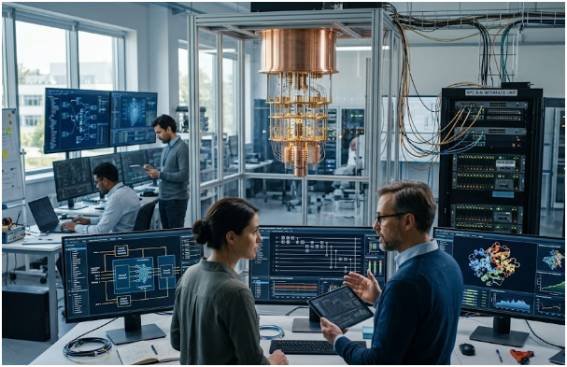
IBM also expanded AI-assisted quantum development through Qiskit Code Assistant and AI-powered circuit-transpilation tools.
Google took a different route with AlphaQubit, an AI-based decoder designed to identify quantum-computing errors. Google reported that the system made fewer decoding errors than several existing approaches in its tests.
That suggests an overlooked 2024 trend: AI and quantum computing were becoming complementary engineering technologies rather than competing futuristic concepts.
Post-Quantum Cryptography Became an Immediate Business Issue
For US businesses, cybersecurity may be the most practical answer to how quantum computing changed in 2024.
On August 13, 2024, NIST finalized its first three principal post-quantum cryptography standards: FIPS 203, FIPS 204, and FIPS 205. They cover quantum-resistant key establishment and digital signatures.
NIST urged system administrators to begin integration immediately because cryptographic migrations can take years.
That changed the enterprise conversation.
Companies no longer needed to wait for a cryptographically relevant quantum computer before acting. They could inventory cryptographic dependencies, identify systems using vulnerable public-key algorithms, improve crypto-agility, and begin planning migrations around finalized standards.
Quantum risk had become a current IT architecture problem, not merely a future security scenario.
Quantum Funding Became More Selective
Investment trends add another layer to how quantum computing changed in 2024.
McKinsey’s 2024 Quantum Technology Monitor reported that private and corporate funding for quantum-technology startups had fallen 27% during the previous measured year. Meanwhile, announced government investment had reached about $42 billion globally.
More tellingly, 62% of startup investment went to companies at least five years old.
I read that as a maturity signal. Investors were becoming less impressed by quantum potential alone. They increasingly wanted credible hardware, intellectual property, engineering talent, and believable routes toward scale.
This mirrors the technical change: the sector was beginning to reward evidence over promises.
What 2024 Did Not Solve
Any useful explanation of how quantum computing changed in 2024 also needs boundaries.
Quantum computers did not replace classical computers. They did not suddenly make RSA encryption obsolete overnight. Most businesses still could not run a quantum workload that produced a decisive commercial advantage.
Large-scale fault-tolerant machines still require major improvements in qubit quality, control systems, fabrication, decoding, and logical-qubit scale.
Google itself describes Willow as a milestone on a longer roadmap, not the finished machine.
The real achievement of 2024 was therefore not completion. It was direction.
The industry gained stronger evidence about which engineering approaches might actually scale for better productivity.
Frequently Asked Questions
1. What was the biggest quantum computing breakthrough of 2024?
Quantum error correction was arguably the biggest shift, especially Microsoft’s logical-qubit results and Google’s below-threshold Willow demonstration.
2. How quantum computing changed in 2024 compared with earlier years?
How quantum computing changed in 2024 was mainly a shift from maximizing physical-qubit counts toward reliable logical qubits, error correction, stable software, and deployment planning.
3. Did quantum computers become commercially useful in 2024?
Not at broad scale; 2024 produced important engineering milestones, but large fault-tolerant quantum computers remained under development.
4. Why did post-quantum cryptography matter in 2024?
NIST finalized three major PQC standards, giving organizations concrete algorithms they could begin adopting for future quantum-resistant security.
Quantum’s 2024 Plot Twist: Reliability Won the Race
When I strip away the giant benchmark numbers and futuristic predictions, how quantum computing changed in 2024 comes down to one word: reliability.
Logical qubits became more credible. Error correction crossed significant experimental thresholds. Software became more stable. AI entered quantum engineering workflows. Cybersecurity teams received finalized US standards they could actually implement.
The smartest next step is not to ask which company has the most qubits. Watch logical error rates, error-correction overhead, logical-qubit scale, and useful hybrid workloads instead.
Those measurements tell us far more about who is getting closer to a quantum computer that can genuinely earn its place beside classical machines.